
Menu
Domestic Services
Commercial Services
cherry picker hire
Contact Us
Approximately 2.5 kilometres of industrial guttering cleared across a live distribution site, with no disruption to normal operations.
Approximate total gutter length
10 valleys and two end gutters
Up to four operatives
No disruption to operations
Before and after nesting season
Pro Clean Xtreme completed a planned commercial gutter-clearance project at a large distribution building at Suffolk Park, Bury St Edmunds, occupied by Skechers and Bleckmann.
The work had been planned since February as part of a twice-yearly maintenance programme: one clearance before nesting season and another afterwards. This four-day visit was the post-nesting-season clearance.
Suffolk Park, Bury St Edmunds
Large distribution building
Commercial gutter clearance
Four working days
Own 21m tracked cherry picker
Photos and end-of-job survey
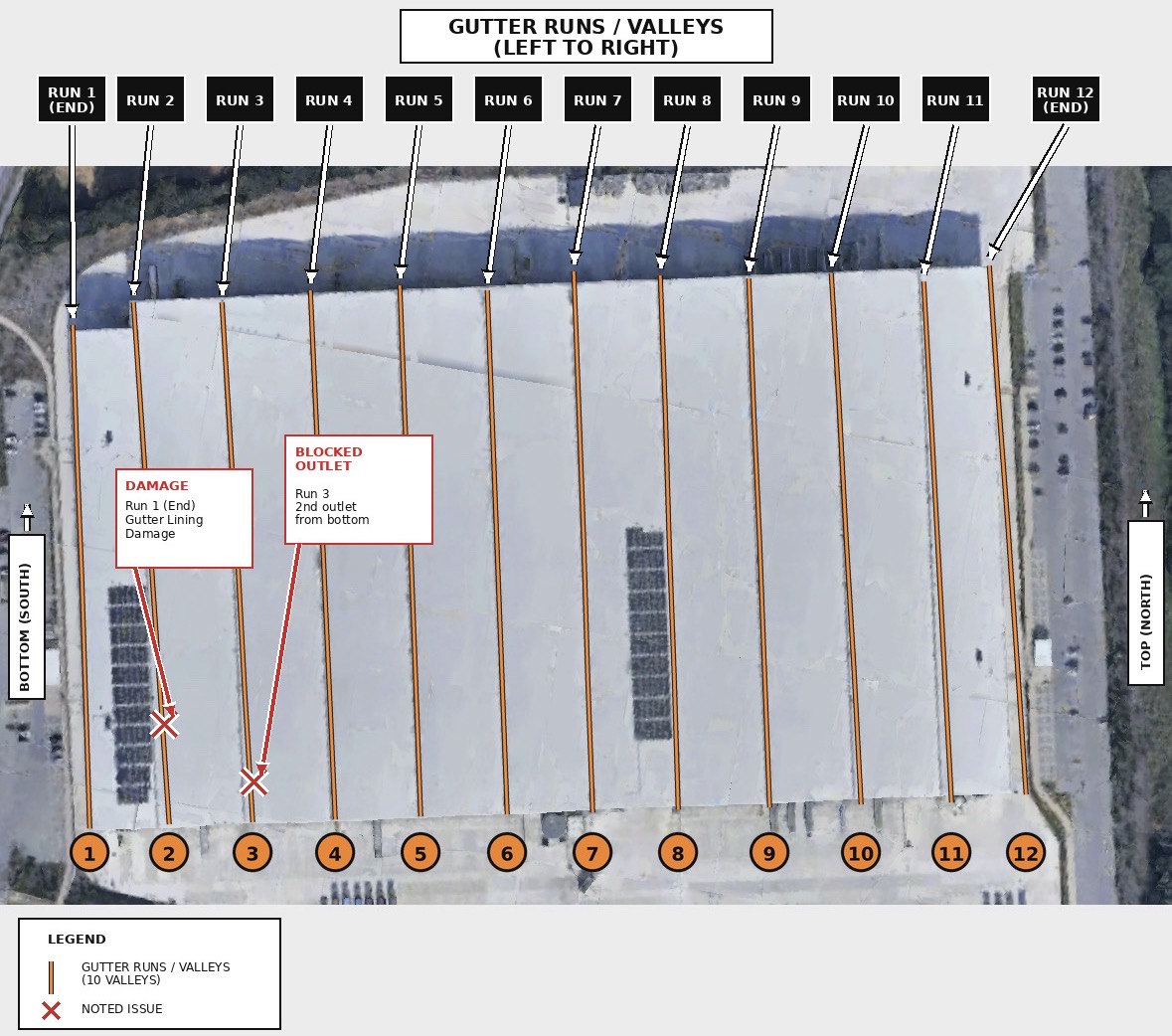
The twelve runs and the two issues recorded in the end-of-job survey.
The roof contains 12 full-length gutter runs: 10 internal valley gutters and two end gutters.
Each run measures approximately 214 metres. Across all 12, that gives an estimated combined gutter length of 2,564 metres—around 2.5 kilometres.
The aerial plan gave the team a clear reference for recording progress and pinpointing any issues discovered.
The distribution centre remained fully operational throughout the project, with no disruption to normal activities.
Pro Clean Xtreme’s own 21m tracked cherry picker was used to access the roof. Once on the roof, the team connected to the existing Mansafe lines wherever required while progressing along the gutters.
The work followed a site-specific RAMS. Because the gutters contained bird fouling, the team used respiratory protection, disposable coveralls and gloves.
The gutters were cleared manually by hand rather than using a gutter vacuum or blower. This gave the team direct access to the gutter channels and outlets.
Cones and barriers separated the work, vehicle and cherry-picker drop zones.
The team used the company’s own 21m tracked cherry picker, then the existing Mansafe system where required.
Feathers, bird fouling and general debris were removed manually and placed into bags.
The covers were unbolted so trapped material could be removed and the accessible outlets checked.
Bagged material was sent down the enclosed chute directly into the skip below.
Conditions, progress, completed runs and visible issues were recorded for the end-of-job survey.
Genuine project photographs show the condition found and a representative gutter after manual clearance.
The feathers, bird fouling and general debris were cleared manually and placed into bags at roof level.
The bags were then sent down a temporary enclosed chute directly into the skip below. This kept the removed waste contained and allowed it to be transferred safely from the roof without disrupting the operational distribution site.
The clearance exposed two separate issues for the building-management team to review.
Visible damage was identified in the gutter lining. Its position was photographed and marked on the annotated roof plan for further review.
The second outlet from the bottom remained blocked. Visible debris was removed and the outlet was plunged, but standing water remained, indicating a restriction beyond the accessible section.
All 12 commercial gutter runs were manually cleared. The accumulated feathers, bird fouling and general debris were bagged and removed for skip disposal.
The appropriate frequency depends on the site, surrounding environment, roof design and previous findings. At this distribution building, a planned clearance takes place before nesting season and again afterwards.
Subject to a suitable site assessment and safe working plan, work can be arranged around normal operations. This four-day project was completed while the distribution centre remained operational and without disruption.
Access is assessed for each site. For this project, our own 21m tracked cherry picker provided roof access and the existing Mansafe lines were used where required.
Where included in the agreed scope, we can provide before, during and after photographs, an annotated site plan, details of the work completed and any visible issues identified.
Send the site address, photographs and any known access restrictions for an initial assessment.
WhatsApp us